
SDMx Blockchain Validator
The Blockchain-Enhanced SDMx Dissemination Platform adds a cryptographic Trust Layer to the SDMx ecosystem.
What is SDMx Blockchain Validator?
The Blockchain-Enhanced SDMx Dissemination Platform adds a cryptographic Trust Layer to the SDMx ecosystem. It plugs into existing SDMx Registries and dissemination workflows to give official statistics an immutable, machine-verifiable audit trail. Standard SDMX-ML payloads are canonicalized (W3C C14N 1.1), fingerprinted with SHA3-512 at both whole-file and per-<Series> granularity, aggregated into a domain-separated, length-prefixed Merkle tree, and anchored to a public ledger (XRPL DevNet for PoC) in a single transaction. The published SDMx file is rewritten to be self-contained, carrying the anchored root, the ordered Merkle leaves, and a W3C Verifiable Credential signed under the publisher’s XRPL key, so any consumer - including DeFi applications and AI-agent verification pipelines - can re-derive the root and verify the publisher’s identity from the file alone plus one ledger lookup, in 1–2 s, with no dependency on the publisher’s backend.
Overview
Why is the framework needed?
In an era characterized by information overload and the rapid proliferation of AI-generated content, the authenticity and integrity of official statistics is paramount for evidence-based policymaking and maintaining public trust. While the adoption of SDMx (the standard for Statistical Data and Metadata) by the Bank for International Settlements (BIS) and other international organizations has streamlined data exchange, current systems lack native mechanisms to cryptographically verify data provenance or detect unauthorized modifications post-publication. This gap poses risks for both consumers and producers: users may struggle to differentiate authoritative data from “hallucinations” or manipulations, while producers face challenges in demonstrating the integrity of their data to automated agents and AI systems. This document outlines a novel, practical implementation framework that leverages blockchain technology to cryptographically enhance the widely adopted SDMx standard. For further details, please refer to the full paper.
Why should institutions use it for official statistics?
We offer a blockchain-enhanced dissemination platform that binds SDMx datasets to an immutable, decentralized ledger. Developed as a Proof of Concept (PoC) using the XRP Ledger (XRPL), the solution provides cryptographic proof of data integrity and origin without disrupting existing statistical workflows.
Our framework provides a pragmatic pathway to enhance the credibility of official statistics in the digital age. It directly supports the “Fundamental Principles of Official Statistics” by ensuring data integrity is verifiable and auditable.
Our contribution in detail:
- An SDMx-native canonicalization and per
hashing pipeline - A domain-separated Merkle aggregation scheme for batched anchoring
- A self-contained, identity-bound verification artefact, in which the SDMx message carries both the ordered Merkle leaves and a W3C Verifiable Credential signed by a publisher identity key cryptographically bound to the publishers Blockchain address via an on-chain attestation registry, so any consumer can re-derive the anchored root and verify the publisher’s identity from the file alone plus a single ledger lookup
- An open-source reference implementation
- Full cost model that captures batch-size/ latency/ fee trade-off and economics, solved for an economically optimal batch size
- A Dolev-Yao network capabilities threat model analysis, selective disclosures via BBS+, Nash anchoring window, multi-publishing accumulator, strategic batching across publishers for Poisson arrival rates and calculations for price of anarchy
- Security, privacy, and governance considerations This system can enable zero-knowledge proofs for any statistical data or metadata and automated verification by AI Agents.
We suggest a sequential implementation approach:
- Pilot Integration: Deploy an architecture to anchor key high-frequency publications (e.g., inflation data, financial stability indicators) to demonstrate enhanced trust without risk to core systems.
- Cross-Agency Collaboration: Explore a shared verification network where international organizations (BIS, IMF, OECD, etc.) act as trust anchors, strengthening collective data governance.
- Smart Contract Exploration: Investigate the use of EVM-compatible sidechains to enable programmable financial instruments that rely on this verified data, paving the way for automated regulatory compliance and digital asset innovation.
What are key use cases?
The platform enables transformative applications that address pressing needs faced by economic, financial and statistical organizations:
| Use Case | Value Proposition | Benefits |
|---|---|---|
| Immutable Version Authentication | Provides cryptographic proof that a published dataset has not been altered, ensuring long-term reproducibility of findings based on official statistics. | Fundamental Principles of Official Statistics: Crucial for policy data (e.g., BIS, ECB, IMF reports). |
| Automated Anomaly Detection | Allows for programmatic monitoring of data series. Anchored metadata supports automated checks (e.g., “CUSUM”) to flag abnormal revisions or potential tampering. | Enhanced surveillance: BIS/IMF macroeconomic monitoring; Central Bank nowcasting. |
| Trusted Third-Party Republication | Enables trusted third-party republication (e.g., media, aggregators) via Verifiable Credentials. Users can verify the data’s origin even when accessed via non-official portals. | Global Dissemination: UN SDG monitoring, World Bank data sharing. |
| Foundation for AI-Based & Smart Finance | Serves as a trusted “oracle” for smart contracts, enabling financial instruments (e.g., inflation-linked bonds) to automatically execute based on verified official data. | Future Finance: DeFi integration, tokenized deposits, CBDCs. |
What are key capabilities and what is the economic performance?
The framework caters to auditability requirements, and allows for real-time operations:
- Immutable Integrity: Creates a tamper-evident audit trail that does not depend on any single central authority.
- Real-Time Verification: Enables users and automated agents to verify data authenticity in less than 2 seconds.
- Production-Ready Performance: Handles dataset publication in under 5 seconds, suitable for high-frequency data releases.
The PoC demonstrates that high-assurance security is economically viable through batching (Merkle aggregation).
- Negligible Cost: By anchoring thousands of datasets in a single transaction, the marginal blockchain fee becomes miniscule. For a batch of 1,000 datasets, the on-chain cost is effectively negligible compared to standard storage and processing costs.
- Scalability: Verification time scales logarithmically with batch size, meaning the system can support millions of datasets while keeping verification times under 2 seconds.
- Efficiency vs. Alternatives: The system is significantly faster and cheaper than traditional Ethereum-based solutions (minutes/hours vs. seconds) or manual PKI management.
Practical Implementation and Architecture
We designed the system to be “plug-and-play,” functioning as an invisible layer of trust that sits on top of your existing infrastructure. It does not replace your current statistical systems; instead, it secures them.
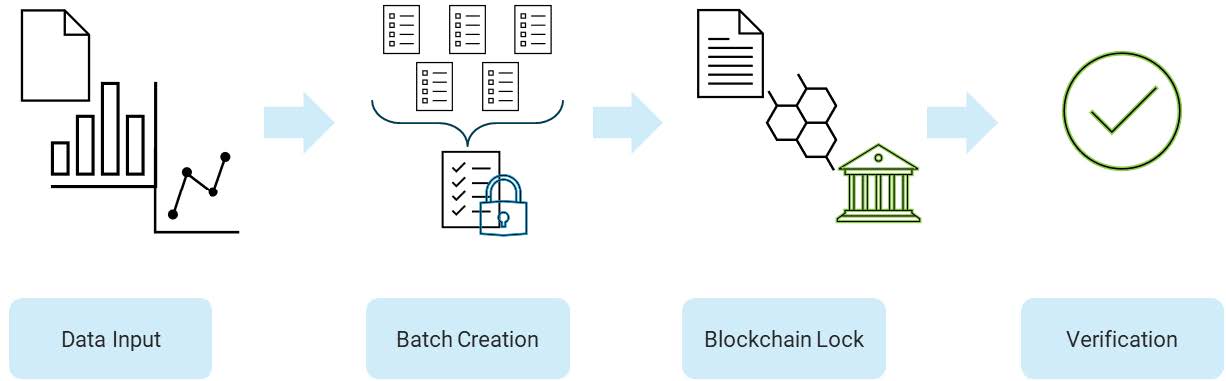
The workflow operates in four sequential steps (as illustrated above):
- Preparation (The “Fingerprint”): When you publish a dataset (using the standard SDMx format), our system automatically creates a unique digital fingerprint of that data.
- Efficiency (The “Batch”): We don’t send every single file to the blockchain individually. Instead, we group thousands of these fingerprints into a single secure batch. This is what keeps costs negligible and speed high.
- Anchoring (The “Lock”): This batch is “anchored” to the public ledger (XRPL). This creates an immutable timestamp, proving exactly what data existed at that moment.
- Verification (The “Check”): Any user—whether a human analyst or an AI agent—can instantly check that their copy of the data matches the fingerprint on the blockchain. If even one number has been changed, the check will fail.
Annex: Technical Innovation Details
Innovative Approach: Technical deep dive for IT and Architecture teams
The solution functions as a cryptographic trust layer that enhances SDMx infrastructure rather than replacing it, ensuring compatibility with current standards.
- Cryptographic Anchoring: The system generates a unique, deterministic “fingerprint” (SHA3-512 hash) for each canonicalized SDMx dataset. These fingerprints are aggregated into a Merkle tree, and the root is anchored to a public blockchain. This proves the data existed in a specific state at a specific time.
- Zero Data Disclosure: Crucially, no sensitive statistical data is stored on the blockchain. Only the cryptographic hashes are recorded, preserving full data confidentiality while enabling powerful integrity checks.
- Blockchain Agnosticism: While the Proof of Concept utilizes the XRP Ledger (XRPL) for its low cost and rapid finality, the microservices architecture is designed to be compatible with other distributed ledgers or smart contract platforms.
License Agreement: Apache-2.0
For more infornation, please refer to SDMx Blockchain Validator:
- Project pages on GitHub: (external link)
- Publication: Rusev M, Schmidt R, Lambe E, Schmieder C, Philip Tice G. Verifiable official statistics: A blockchain-based approach. Statistical Journal of the IAOS. 2026;0(0). (external link)
Need help finding something? I am an AI Assistant that's here to help!
Welcome to SDMx AI assistant
What are you looking for?
By using this AI-powered service ("Service"), you acknowledge and agree to the following:
This Service uses generative AI to assist with statistical analysis and research. While the Service strives to deliver useful information, the output ("Output") may contain inaccuracies, omissions, or biases. The Output is provided for informational purposes only and should not be considered professional advice. You remain responsible for how you interpret and use the Output.
The BIS makes no warranties regarding the accuracy or completeness of the Output and accepts no liability for any loss or damage resulting from its use.
Do not include or share personal, private, confidential or proprietary information when using the Service.
By using this technology, you agree to the Terms and Conditions.
How the assistant can help you
Understand SDMx standards
Ask and get clear explanations about SDMx standards.
Navigate the website
Find tools and documentation on website quickly.
Explore SDMx tools
Ask about API, software and libraries supporting SDMx.
Access documentation
Locate technical guides, specifications, and FAQs.